

Article: Is SEO Dead in 2026? Why Search Is Changing, Not Disappearing
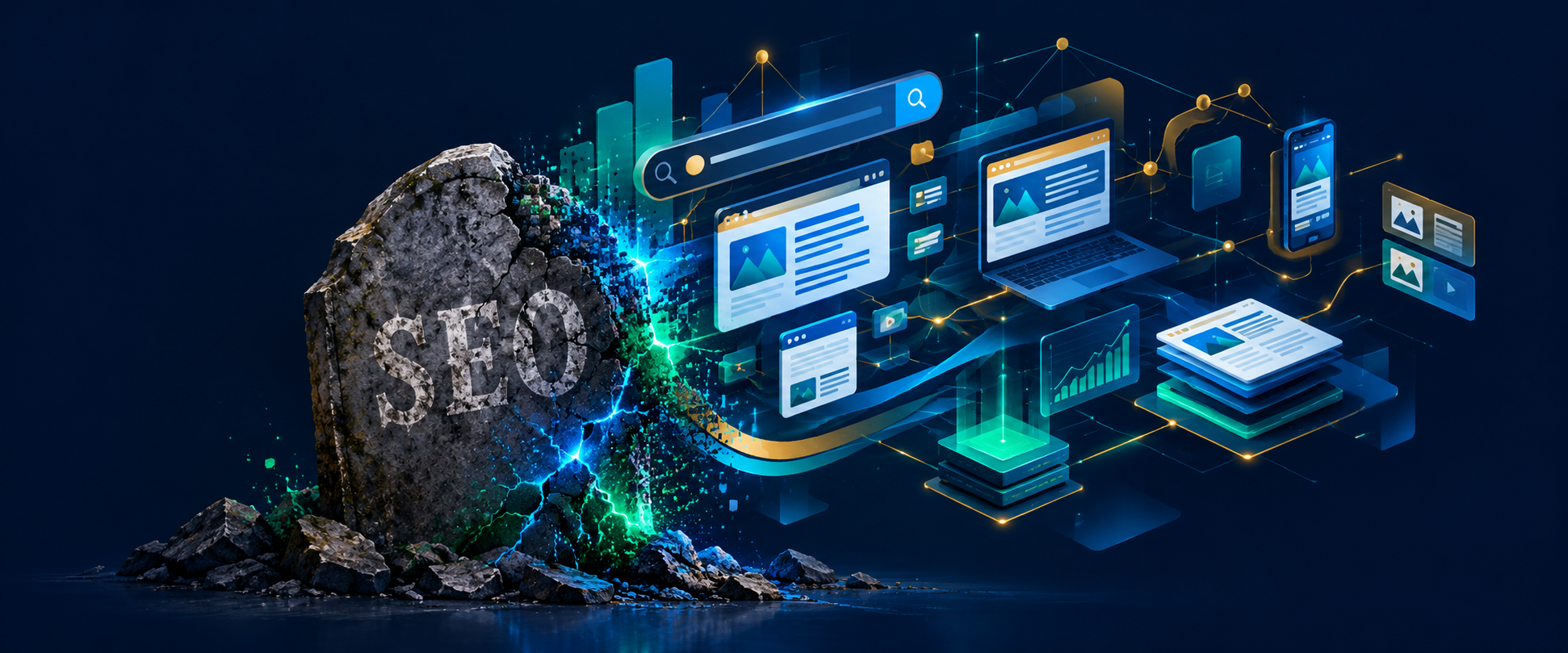
Is SEO Dead in 2026? Why Search Is Changing, Not Disappearing
Every few years, someone declares that SEO is dead.
First it was keywords. Then it was directories. Then social media was supposed to make search irrelevant. Then voice search was going to change everything overnight. And now, right on schedule, AI is supposed to be the thing that finally kills SEO for good.
Yet here we are in 2026, and businesses are still investing in organic search. Marketing teams are still hiring SEO specialists. Founders are still asking the same question they've asked for two decades, just with a new twist: "Is SEO dead, or is this AI thing actually different?"
At Code to Couture, we've worked on SEO and digital marketing across a range of businesses, from fashion labels like Astha Narang and Gargee Designer to brands such as Dohr India, Surmaye, Banjara Trail, Simitri, and Stotram Designer. Different products, different audiences, different competitive landscapes. If there's one thing that experience has reinforced, it's this: SEO doesn't die. Specific tactics die. And people often confuse the two.
SEO Has Been "Dead" More Times Than We Can Count
If you've been in digital marketing long enough, you've probably seen "SEO is dead" articles written about every major shift in how people search. It happened when Google's algorithm updates wiped out keyword-stuffed pages. It happened when directory listings stopped moving the needle. It happened when everyone assumed Instagram and TikTok would replace Google for an entire generation. It's happening again now, with ChatGPT and AI Overviews being framed as the final nail in the coffin.

The pattern is oddly consistent. A new technology arrives, search behaviour shifts a little, some tactics stop working, and someone writes an obituary for the entire discipline. A few years later, the obituary looks premature, and a new one gets written for the next big shift.
Why People Keep Predicting the Death of SEO
There are a few honest reasons this keeps happening, and it's worth understanding them rather than dismissing them outright.
Search behaviour keeps changing
People genuinely search differently than they did ten years ago. Voice queries are more conversational. Mobile search dominates over desktop. Younger users often start product research on Instagram or Reddit rather than Google. All of this is real, and it does change what "ranking well" actually means.
Old SEO tactics stop working
When Google tightens its algorithm or changes how it evaluates content, tactics that used to work suddenly don't. That's not proof that SEO is dead, it's proof that the tactic was never sustainable in the first place.
New technology creates uncertainty
Whenever a new platform or interface appears, nobody has a playbook for it yet. That uncertainty gets mistaken for irrelevance. It happened with my mobile. It's happening now with AI-generated answers.
What Actually Happened to Old-School SEO?
This is where the nuance matters. Old-school SEO the version built on keyword stuffing, low-quality directory submissions, manipulative backlink schemes, thin content, and duplicate pages designed purely to rank is genuinely dying, and has been for years.

Search engines got better at detecting manipulation. Users got better at spotting low-value content. What used to be loopholes became liabilities. When these tactics stop working, it's easy to mistake the death of the tactic for the death of the discipline. But SEO was never really about tricking an algorithm, it was always about being findable by the people who need what you offer. The methods for doing that have changed. The underlying need hasn't.
Social Media Was Supposed to Replace Search
For a while, the dominant narrative was that social media would replace search entirely, particularly among younger audiences discovering brands through Instagram, TikTok, and YouTube rather than Google.
Social media did become a massive discovery channel. That part is true. But discovery and intent are not the same thing. Someone scrolling through Instagram might discover a fashion brand they didn't know existed. But when they're ready to check reviews, compare prices, look up sizing details, or find the brand's website, they very often turn to search. Social platforms are excellent at sparking interest. Search remains where people go to act on it. That's why brands with a strong social presence still invest heavily in SEO; the two channels do different jobs.
Now AI Is Supposed to Kill SEO
The current version of this argument centres on ChatGPT, AI assistants, and Google's AI Overviews. The logic goes: if AI can just answer the question directly, why would anyone click through to a website?
It's a fair question, and AI is genuinely changing the search journey. More people are getting quick answers without visiting a website at all for simple queries. That's a real shift, and it does affect click-through behaviour for certain kinds of searches.
But it's worth being careful here AI-powered search experiences still rely on information published across the web to generate their answers. Businesses that don't have a credible, well-structured, informative online presence have less chance of being referenced, recommended, or discovered by these systems in the first place. Rather than eliminating the need for good content and technical quality, this arguably raises the bar for it.
So What Does SEO Mean in 2026?
Modern SEO looks quite different from the version most people learned five or ten years ago. It's less about stuffing a keyword into a page a certain number of times, and more about a combination of factors working together:
- Search intent : understanding what someone is actually trying to accomplish, not just what words they typed.
- Helpful, original content : content that answers a real question better than what already exists.
- First-hand experience : showing that you actually know the subject, not just summarising it.
- Topical authority : demonstrating depth across a subject area rather than one-off pages.
- Technical SEO : site speed, crawlability, mobile performance, clean architecture.
- Structured data : helping search engines and AI systems understand what your content actually represents.
- Internal linking : connecting related content so both users and search engines can navigate your site logically.
- Brand authority and digital PR : being mentioned and trusted across the web, not just linked to.
- Entity relevance : being recognised as a credible source connected to a specific topic, product, or industry.
- Page experience : how a page actually feels to use, not just how it's coded.
- Conversion-focused traffic : ranking is meaningless if the people arriving don't take any action.
None of this is entirely new. What's changed is how much weight each factor carries, and how unforgiving search engines and AI systems have become toward content that's thin, generic, or clearly written to game a system rather than help a person.
From Our Experience at Code to Couture
Working across different brands, fashion labels, design studios, and businesses in different niches has taught us that SEO is not a one-size-fits-all activity, no matter how many "SEO checklists" suggest otherwise.
A few observations that have held true across nearly every project we've worked on:
- Every website has a different search intent profile. What works for one fashion brand's product pages doesn't automatically translate to another's, even in the same industry.
- Technical issues quietly cap organic performance. A site can have decent content and still underperform because of slow load times, poor mobile experience, or a confusing site structure.
- Content has to match what users are actually looking for, not what a business wants to say about itself. These are often two different things.
- Ranking for a keyword means very little if the traffic that arrives doesn't convert. Visibility and revenue are related, but they're not the same metric.
- SEO works best in coordination with website UX and content strategy treating it as a standalone checkbox activity rarely produces meaningful results.
- SEO is a long-term process. Businesses expecting overnight results are usually the ones who give up right before things start working.
None of this is a dramatic revelation. But it's the kind of thing you only really understand after working on enough different websites to see the same patterns repeat.
The Biggest SEO Mistake Businesses Are Making in the AI Era
The most common mistake we see right now is businesses treating SEO purely as "ranking for keywords on Google," and then panicking the moment that specific mechanism looks threatened by AI.
SEO has always been broader than that, even when most people didn't describe it that way. The real goal has always been organic discoverability being found by the right people, through whichever channel they happen to be using. Google search happens to be the biggest of those channels, which is why it became shorthand for the whole discipline. But it was never the only one, and treating it as the only one is what makes AI feel like an existential threat rather than another channel to account for.
SEO + AI: Competition or Collaboration?
The honest answer is: both, depending on how you look at it.
AI is genuinely useful for a lot of SEO work research, content ideation, generating outlines, running technical audits, analysing data at scale, and automating repetitive parts of the workflow. Used well, it can make an SEO process faster and more consistent.
What AI doesn't replace is judgment. Strategy, fact-checking, originality, understanding a specific brand's voice and audience, and knowing which recommendations actually make sense for a particular business these still require someone who understands both the business and the medium. Content produced purely to fill a quota, without editorial oversight, tends to be easy to spot and easy to ignore, whether it's read by a person or evaluated by an AI system.

What Businesses Should Focus On Now
If you're trying to figure out where to put your energy in 2026, a practical starting point looks like this:
- Fix technical SEO issues before anything else.
- Understand search intent for your actual audience.
- Create content that's genuinely useful, not just present.
- Demonstrate first-hand expertise wherever possible.
- Build topical authority instead of scattering one-off pages.
- Strengthen internal linking across your site.
- Improve overall website UX.
- Build brand authority through credible mentions and digital PR.
- Monitor organic traffic and conversions together, not traffic alone.
- Optimise for evolving search experiences, including AI-powered ones.
- Use AI as a productivity tool, not a replacement for strategy.
- Keep adapting this list to look different again in a few years.
The Future of SEO Is Bigger Than Google
People now discover businesses through Google Search, AI Overviews, ChatGPT and other AI assistants, YouTube, Reddit, social media, Maps, marketplaces, brand websites, and online forums. That's a meaningfully wider set of channels than a decade ago, when "search" mostly meant one search engine and a page of blue links.
This is why it makes more sense to think of modern SEO as search visibility, or organic discovery, rather than narrowly as "ranking on Google." The core skill set of understanding intent, building authority, and creating genuinely useful content applies across all of these channels, even though the tactics for each one differ.
So, Is SEO Dead?
No. But the version of SEO built on keyword stuffing, low-quality backlinks, thin content, and chasing rankings without understanding users is becoming increasingly irrelevant and has been for a while.
What's replacing it isn't the absence of SEO. It's a version of SEO that takes search intent, content quality, technical performance, brand trust, and AI-powered discovery seriously, together, rather than treating any one of them as the whole job.
Different predictions. Different technologies. The same lesson: search keeps evolving, and so does the work of being found within it.
FAQ Section
-
Is SEO dead in 2026?
No. SEO isn't dead, but outdated tactics like keyword stuffing and low-quality backlinks are increasingly ineffective. What's changed is the definition of good SEO, not the need for it. -
Will AI replace SEO?
AI is changing how people discover information, but it still depends on well-structured, credible content published across the web. AI is more likely to reshape SEO than eliminate it. -
Is SEO still worth investing in?
For most businesses, yes. Organic search remains a major discovery channel, and strong SEO fundamentals also improve site quality, user experience, and overall online credibility. -
What does SEO look like in the AI era?
It focuses on search intent, helpful and original content, technical performance, topical authority, and visibility across multiple discovery channels — not just ranking for keywords on Google. -
What should businesses focus on for SEO in 2026?
Fixing technical issues, understanding user intent, producing genuinely useful content, building brand authority, and treating SEO as a long-term, evolving strategy rather than a one-time task.