

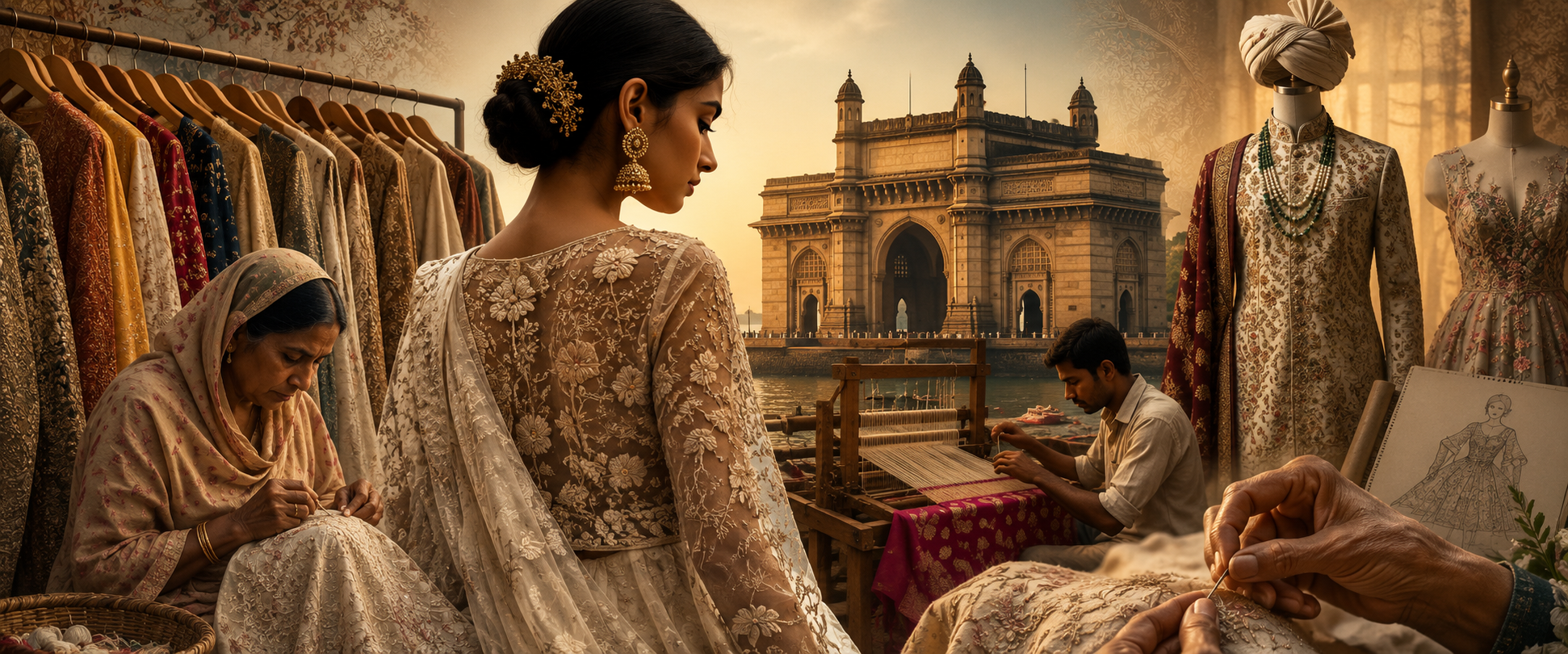
From Craft to Catwalk, Without the Credit
Made in India (Just Don’t Tell Anyone)
Indian craftsmanship: renowned, but only when it’s repackaged with a foreign label.
Desired? Definitely, but only once it’s passed the litmus test of global approval.
Unfortunately, it’s revered only when paired with a European accent and a five-digit price tag. (In $, mind you.)
This is the reality.
It’s the classic “my-parents-were-right” syndrome.
Except this time, the parent is Indian craftsmanship. Relentless, brilliant, quietly undefeated. (But you only admit it after your third therapy session.)
Here’s that therapy session in 500 words.
From raw to refined, futuristic to nuanced, we’ve been building couture with soul for centuries.
Deeply skilled. Madly versatile. And rarely given credit. (Until someone from the West validates it, of course.)
So let’s talk about it, because why not.
It’s long overdue.
THE BIG SHOCK
When Prada released their now-famous embroidered jackets, fashion Twitter went breathless.
“Such intricate work,” they (fake) gasped, clutching their oat lattes.
Yes, we nodded nonchalantly. Kajol aunty’s 1996 blouse had that same zardozi.
And her tailor did not need an Italian muse board to get it right.
Global brands are now in a full-blown love affair with Indian craftsmanship.
Kantha showed up in Milan. Kalamkari strolled through Copenhagen.
Chikankari was front and center at Dior’s Pre-Fall 2023 show in Mumbai, held dramatically in front of the Gateway of India. (Ironic, no?)
Meanwhile, some Parisian CEO just “invented” sustainable slow fashion by... using handloom. Revolutionary. (Guess what was the last stamped country on the passport.)
THIS IS NOT A COSTUME PARTY
Diljit Dosanjh arrived at the Met Gala like couture royalty.
Dressed in a sherwani inspired by phulkari, that iconic embroidery tradition from Punjab.
Styled with intention. Worn with quiet defiance. Designed by Gaurav Gupta.
It wasn’t a look. It was a message.
Indian craft is not a supporting act. It is the main character.
And yet, even there, he reportedly wasn’t allowed to wear a traditional Indian heritage necklace from Cartier’s archives. Let that sit with you.
A British brand, preserving an Indian historical piece they “acquired.” (Vocabulary check: looted is the right word.)
Meanwhile, foreign celebrities walk red carpets dripping in “global influences,” most of which originate from artisans they couldn’t locate on Google Maps.
TO THE CLOUT CHASERS
There’s something quietly uncomfortable about watching our culture walk the world’s runways while we stand a few steps back, unsure whether to cheer or claim it. The embroidery is Indian. The fabrics are Indian. The silhouettes carry centuries of memory. The faces often are too. And yet, the applause feels slightly misdirected.
Somewhere along the way, we curated a kind of distance. Close enough to admire, but not quite close enough to take ownership. The garments speak our language. We just stopped replying.
The problem isn’t absence. It’s amnesia disguised as trend fatigue. We wait for international validation before we rediscover what was always ours. A motif becomes sacred once it appears in a lookbook abroad. A stitch earns value only after it crosses time zones.
Culture doesn’t need translation services. It needs a memory jog. It doesn’t crave reinvention. It simply asks to be seen, honestly, and worn without a filter.
So maybe now’s a good time to stop filming our matcha pours and start sipping cutting chai with the same aesthetic ambition. Let the background be noisy. Let the cup be steel. Let it be real.
Because heritage never asked for reinterpretation.
It asked to be recognised.
And that begins with us.
THE REALITY
Chikankari hails from Lucknow and takes hours of handwork to finish a single motif.
Bandhej belongs to Gujarat and Rajasthan, dyed in swirls of skill passed down through generations.
Kanjeevaram silk comes from Tamil Nadu and holds its own beside any European jacquard.
Toda embroidery, born in the Nilgiri hills, is a spiritual process as much as a design one.
These are not trends. They are legacies.
Our artisans are not “local labour.” They are living archives.
Some of them carry stitches their great-great-grandparents once perfected.
Some of them create techniques that design schools are still trying to figure out.
This is not about gatekeeping.
It’s about finally holding the door open for the people who built the house.
THIS IS WHY WE DO WHAT WE DO
At Code to Couture, this is our heartbeat.
We exist to bring things into perspective.
To help the world see what has been in front of them all along.
To amplify, not appropriate.
Indian craftsmanship doesn’t need saving.
It needs amplifying.
It’s not a niche. It’s not exotic. It’s not a trend.
It is the foundation. Of style. Of luxury. Of couture.
And the world needs to stop borrowing it without credit.
So the next time someone raves about a “hand-embroidered” couture gown in Paris, ask them where it was made.
Chances are, the hands behind it were from Surat, or Bhuj, or a village your Google Maps won’t show you.
And those hands? Deserve more than applause.
They deserve recognition.
If you’re a couture brand, a creative visionary, or someone building the future of fashion with craft at its core, we’re here.
Let’s build something iconic, together.
And give credit where it has always been due.


%0AIndian%20craftsmanship:%20renowned,%20but%20only%20when%20it%E2%80%99s%20repackaged%20with%20a%20foreign%20label.Desired?%20Definitely,%20but%20only%20once%20it%E2%80%99s%20passed%20the%20litmus%20test%20of%20global%20ap...)